21. Merge Two Sorted Lists
Status: Solved
Difficulty: Easy
Relevant Guides: Linked List Guide
Problem Statement
You are given the heads of two sorted linked lists list1 and list2.
Merge the two lists into one sorted list. The list should be made by splicing together the nodes of the first two lists.
Return the head of the merged linked list.
Example 1:
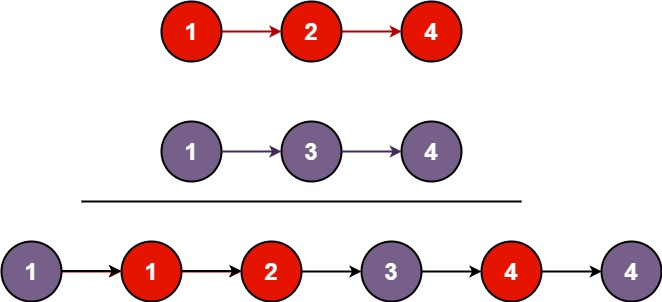
Input: list1 = [1,2,4], list2 = [1,3,4]
Output: [1,1,2,3,4,4]
Example 2:
Input: list1 = [], list2 = []
Output: []
Example 3:
Input: list1 = [], list2 = [0]
Output: [0]
Constraints:
- The number of nodes in both lists is in the range
[0, 50]. -100 <= Node.val <= 100- Both
list1andlist2are sorted in non-decreasing order.
Intuition
Both lists are already sorted in non-decreasing order.
The key constraint is not to copy values in memory but to reuse the existing nodes from the input lists. That means we need to sequentially rewire each node up to the next sorted position.
The strategy is to repeatedly compare the front node of each list and attach the smaller one to the tail of the merged list. A dummy node provides a stable starting point so every insertion follows the same logic, including the first one.
graph TD
    START((Merge Two<br/>Sorted Lists))

    Input[/Input:<br/>list1, list2/]

    bound{Are both lists<br/>non-empty?}

    compare{Which front node<br/>is smaller?}

    append[Append smaller node<br/>to result]

    advanceList[Advance the list<br/>that supplied it]

    advanceTail[Advance result tail]

    leftovers[Append the remaining list]

    END([Return merged list])

    START --> Input --> bound
    bound -- Yes --> compare
    compare --> append --> advanceList --> advanceTail --> bound
    bound -- No --> leftovers --> END
Implementation
- Create a dummy node and a current pointer
- While both lists have nodes:
- compare the current values
- attatch the smaller node to current.next
- advance the pointer of the list we took the node from
- move current forward
- When once lists is empty, attatch the rest of the other list
- Return dummy.next (the real head of the merged list)
from typing import Optional, Any
# Definition for singly-linked list (expanded).
class ListNode:
    def __init__(self, val: Any = 0, next=None):
        if next is not None and not isinstance(next, ListNode):
            raise TypeError("`next` must be a linked list or None")
        self.val = val
        self.next = next

    def __repr__(self) -> str:
        next_id = hex(id(self.next)) if self.next else None
        return f"ListNode(id={hex(id(self))}, val={self.val}: {type(self.val)}, next={next_id})"

    def inspect(self):
        current = self
        while current:
            print(current)
            current = current.next


class Solution:
    def mergeTwoLists(self, list1: Optional[ListNode], list2: Optional[ListNode]) -> Optional[ListNode]:
        dummy = ListNode()
        current = dummy

        while list1 and list2:
            if list1.val <= list2.val:
                current.next = list1
                list1 = list1.next
            else:
                current.next = list2
                list2 = list2.next
            current = current.next
        current.next = list1 or list2
        return dummy.next
Complexity
- Time: $O(n + m)$
Each node from both lists is visited exactly once.
- Space: $O(1)$
The algorithm only uses a few pointers (dummy, current, list1, list2).
No new list is allocated—the existing nodes are reused.
Key Takeaways
- A dummy node removes the special case for inserting the first element
- The
currentpointer always represents the tail of the merged list. - Moving a pointer (
list1 = list1.next) does not modify the list; it only changes where our local reference points. - Reassigning
current.nextrewires the linked structure without creating new nodes - Once one list is exhausted, the remaining nodes of the other list are already sorted and can be appended directly.
- Advancing a pointer never changes the underlying linked list—it only changes which node your variable refers to.
Common Mistakes
- Creating new nodes instead of reusing existing ones.
- Comparing
ListNodeobjects instead of their values. - Forgetting to advance
current. - Forgetting to advance the list whose node was consumed.
- Returning
dummyinstead ofdummy.next. - Forgetting to append the remaining nodes after one list is exhausted.